Google Maestro
A real-time quiz platform built for ACES techfest where participants race to research and answer questions live, replacing the old Google Forms workflow entirely.

Note: This project is built specifically for ACES’s use case and is intended to be deployed as a single-organization instance.
The Problem
ACES runs an annual national-level techfest where Google Maestro is one of the main events — a research-based quiz where participants race to find answers across the web. Every second matters.
The old system used Google Forms — admins created a new form for each question, participants had to re-enter their name and email every time, and checking results meant manually sorting responses after each round. It was slow, error-prone, and completely impractical for a fast-paced live event where fairness depends on real-time accuracy.
What I Built
I was the primary developer on this, with other ACES members contributing to some frontend pages and testing. The stack is NestJS, React, and WebSockets.
Tenant-based architecture — Each deployment of Google Maestro acts as a single organization’s server. The org name and super admin email are configured at hosting time, and the super admin account is created automatically on first run.
Admin controls — The super admin can invite other admins. Admins create quizzes, add rounds, populate questions for each round, and invite participants.
Lobby system — Participants join using a unique code and wait in a lobby until the quiz begins.
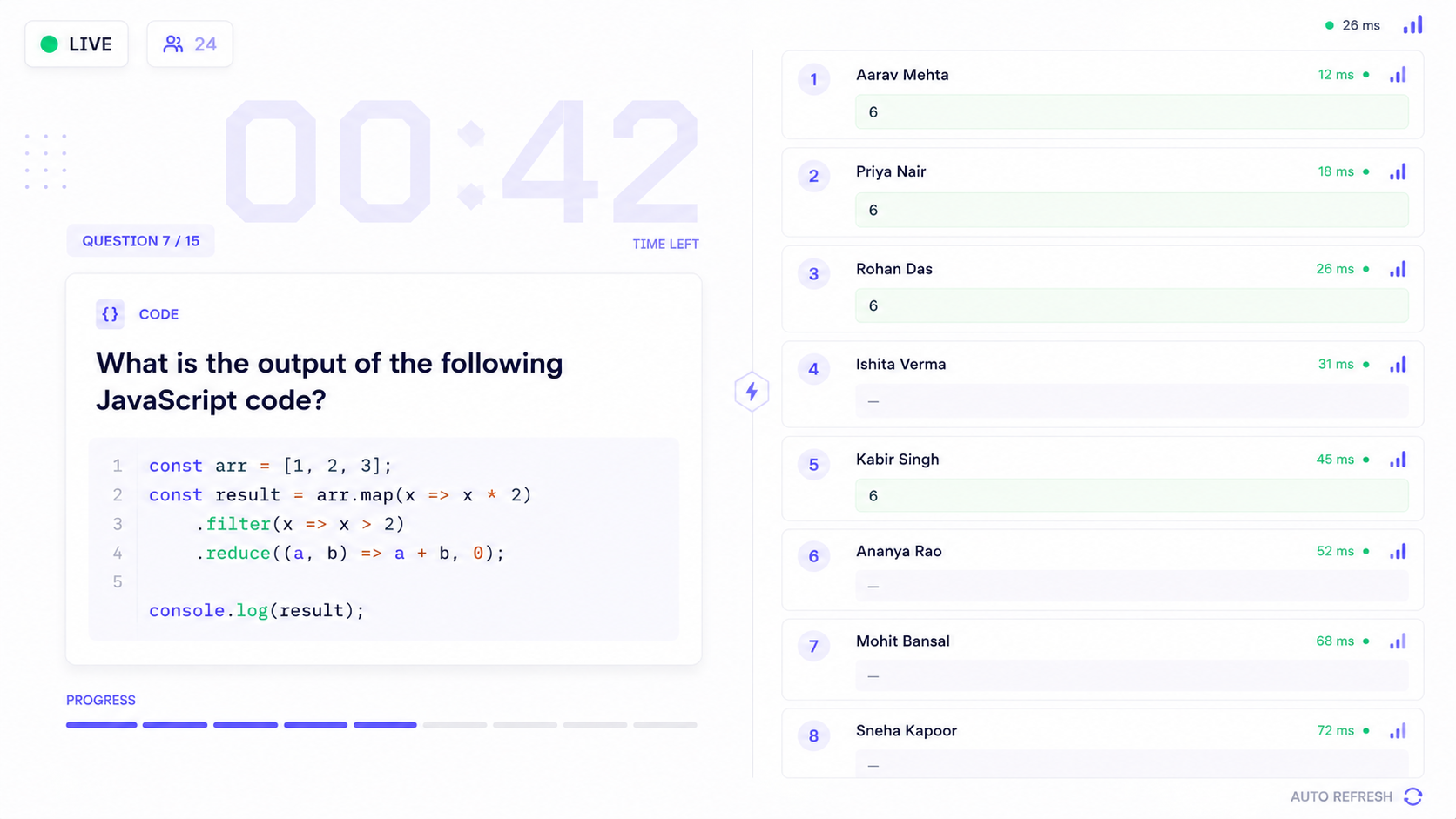
Real-time question delivery — Questions are pushed to all participants simultaneously via WebSockets — no one sees the question before anyone else. Participants type their answers directly, with paste disabled to keep it fair.
Manual answer verification — When all participants have answered or time runs out, the admin reviews responses and manually marks which ones are correct. The system then updates scores and moves to the next question.
Leaderboard & results — Scores are tracked across rounds and the winner is determined at the end.
Technical Challenges
Building the real-time layer with WebSockets was the core challenge — making sure questions were delivered to every participant at exactly the same moment and that answer submissions were timestamped accurately. Fairness in a live competitive setting doesn’t leave room for lag or inconsistency.
Results & Impact
Google Maestro was used at the ACES techfest with around 20 participants across 5 rounds. The shift from Google Forms to a dedicated real-time system made the event noticeably smoother — no re-entering details, no manual form creation between questions, and a proper live experience for participants.
The project is complete for ACES’s use case and open source on GitHub. A more flexible plugin-based version called Recon is currently in development.